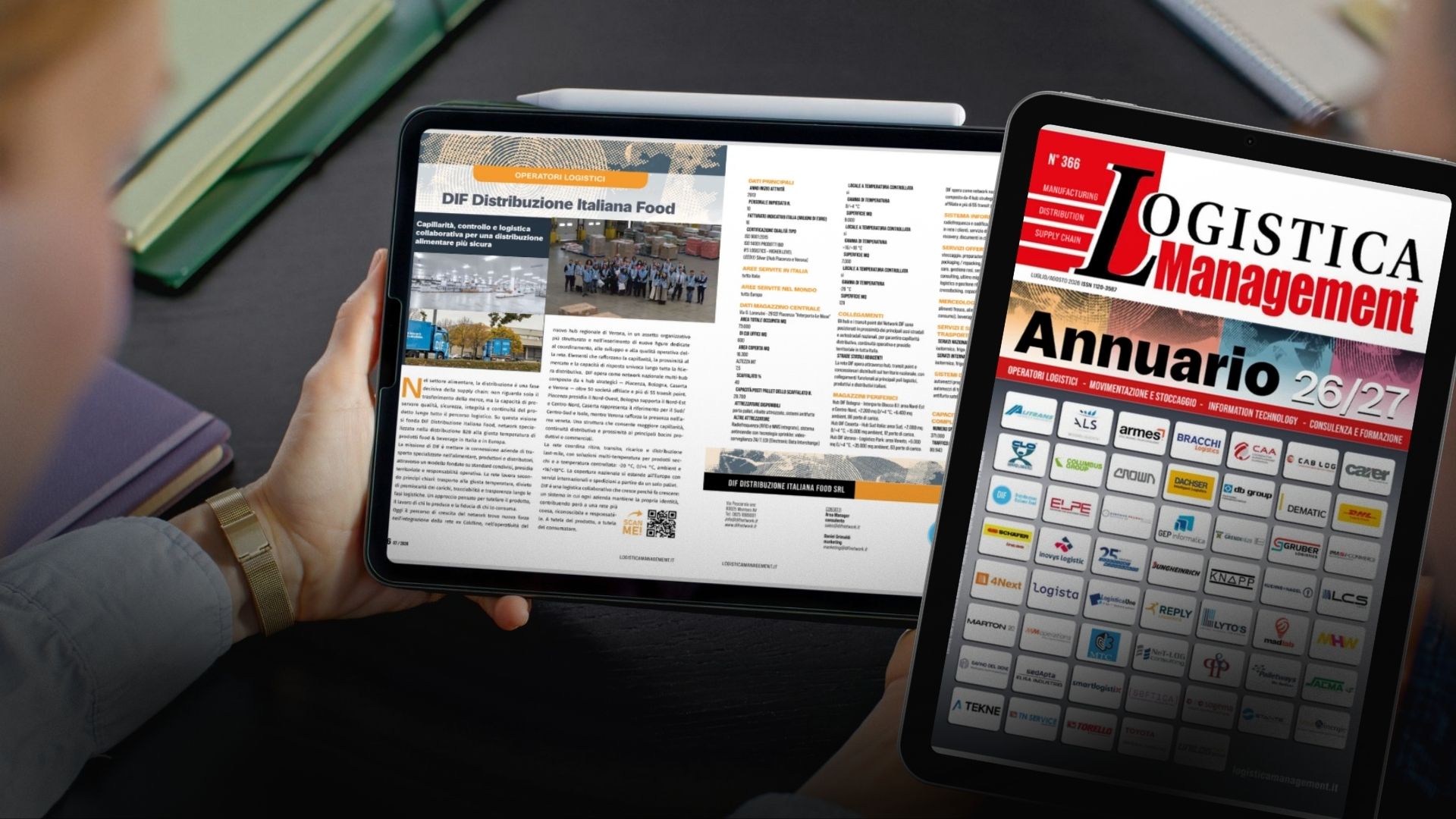
DIF in the 2026/2027 Logistica Management Yearbook
Network development, a new hub and operational capabilities: the updated profile of Distribuzione Italiana Food
The company page dedicated to DIF – Distribuzione Italiana Food is now available in the 2026/2027 Logistica Management Yearbook.
The publication provides an updated overview of the Network’s growth path: the expansion of the network, the addition of new companies, the strengthening of its hubs and the evolution of the operational structure supporting food & beverage distribution.
The feature explains how DIF is consolidating its distribution model, expanding its territorial coverage and improving coordination between companies, infrastructure and specialist expertise.
A network dedicated to food distribution
Food distribution requires specific expertise, infrastructure and procedures. It is not simply about moving goods, but about controlling the conditions under which each product is collected, handled, stored and delivered.
DIF coordinates specialist transport companies, hubs e transit points
through shared standards based on clear principles:
- product management at the correct temperature;
- no mixed loads with non-food goods;
- shipment traceability;
- transparency throughout the logistics process;
- service continuity and consistency across the territory.
The network was created to protect products, recognise the value of the work carried out by producers and provide greater reliability to distributors, large-scale retail operators, Normal Trade, Ho.Re.Ca. businesses and wholesalers.
A network that continues to evolve
In recent years, the Network has strengthened its presence through the addition of new companies, broader territorial coverage and an increasingly structured organisation.
The integration of the former Coldline network, the operational launch of the Verona hub and the appointment of new professionals dedicated to coordination, development and operational quality are helping to make the Network more extensive and closer to the main production and distribution areas.
This development concerns not only the number of operational locations, but also the ability to work as a single system. Network companies, hubs, transit points and central functions operate according to shared standards to ensure continuity, control and consistent service quality.
Today, the network is structured around four strategic hubs:
Piacenza: the Piacenza hub, located at the Le Mose Logistics Centre, is a key reference point for North-West Italy and for national network connections. The facility includes dedicated areas for different temperature ranges, including storage for fresh, frozen and positive temperature-controlled products.
Temperature ranges: 0/+4°C, ambient and -20°C.Bologna: the Bologna hub, located at Interporto Block 8.1, supports North-East and Central-Northern Italy. It includes dedicated areas for fresh and ambient products and has significant capacity for transit and cross-docking activities.
Temperature ranges: 0/+4°C and ambient.Caserta: the Caserta hub serves Southern and Central-Southern Italy, as well as connections with the islands, bringing the Network closer to the territories and distribution channels of Southern Italy.
Temperature ranges: 0/+4°C and ambient.Verona: the new Verona hub strengthens DIF’s presence in the Veneto region and increases the Network’s response capacity in North-East Italy, one of the country’s most important areas for food production and distribution.
Temperature ranges: 0/+4°C and ambient.
This structure brings the Network closer to the main production and distribution areas, reduces operational distances and improves coordination between collection, transit, reloading and last-mile distribution. More extensive territorial coverage also strengthens the ability to serve channels and regions with different operational requirements.
Read the DIF company page in the Logistica Management Yearbook
The Logistica Management publication explores DIF’s development path, network structure, hub characteristics, services and operational capabilities supporting food distribution.
A network built to protect the value of food
DIF supports producers, distributors and transport companies through an organised, extensive network specialised in food distribution.
Producers and distributors
Transport companies